


Currently Reading:
Homestuck (~50%)
The Devils (~40%)
Latest Update:
New Blog: Finding Communities and Causes near you!
new mini blogs!Updated:
May 27th, 2026
Oats' Guide to the Stars
Posted April 30th, 2026
Heyo everypony! i fucking love stargazing. It's one of the few times i can hone my mind, appreciate the spectacular view around me, and if need be have conversations to my thoughts i can only really get while meditating. It's awe-inspiring, and helps you realize how big of a universe there is around us, one the few feats i love to show to people cause its something where you can't just be on your phone the whole time -- you really just experience the moment together.
But with that being said, i have had plenty of talks from friends, familiars, and total strangers at this point asking "wait that sounds so cool but how do you know where to go?" The answer always goes on for as long as you think this autistic puppygirl can yap on about, which is at least 15 mins and up to an hour depending on how focused and awake i am. So, i wanted to make this an official guide for anyone so that i can always point them towards this if they need a refresher, i don't feel like yapping, or i want them to have the links and resources that can sometimes be hard to give out in person!
All links will be also linked in the bottom here so that in case you just wanted those links and resources again you can easily grab them, as well as a quick tldr in case my yapping is too long or just want the quickest refresher.
Part 1:
Light Pollution and you!
Light shining into 🫵🏼 you. 🫵🏼
It's very hard to focus on such a tiny amount of light a star sends to us if there's lots of bigger lights blocking your view. Even just lights from streetlamps, car headlights, or from a building in your way will massively change the amount of stars you can see! Even in a really badly light-polluted city, the difference between no lights in your eyes vs streetlamps around you can make the difference between no stars at all or actually seeing a variety of constellations. Going to a park at night for example can really show the difference.Light pollution from your city.
In a similar manner, the light aggregated from all over your city can bounce off clouds or just move through the atmosphere, its rays going in every direction. These same light rays can end up affecting what you see, since even though they may be no lights around you, rays from miles away from you will eventually cross to your direction miles up in the sky. Due to this, the places with the clearest darkest skies will usually have no city or even town for miles, though even just going 10-15 miles away from a main city can let you see literally HUNDREDS of stars.This map gives the most accurate data, as it's gathered light pollution data from 2025, and even has a colorblind setting. In general the white is the worst, and black is the best, but what this light map doesn't tell you is exactly what the colors mean.
For example, if you've lived in the White and/or red areas all your life, going to a yellow/green spot (which might not even be an hour away) can get you to seeing hundreds of stars, green maybe even more than a thousand if you stay and watch the stars move. However, there's no good information on this site to illustrate this.
This map is slightly outdated, showing 2022 light population info, but what it lacks in updated info, it gives you a much better description of what the colors mean if you simply scroll down. It gives them in good astronomical terms, and in a much better depth of the colors, but for now i'm gonna give you a basic rundown.
~~~~~~~~~~~
The light pollution color chart is as follows!
You can usually get to a yellow spot from around an hour trek of the city you dwell in (in my experience) and could be a good first place you really try to stargaze if you haven't ever before and you live in a white/red area. A lot of dark Sky/stargazing spots in your area start at yellow or green so you can also give those a shot too.
What was a hundred or so stars in the sky can feel like multiple hundreds now. At this point, even the dim constellations like Cancer should be able to be seen in the sky, and in the right conditions so can the milky way.
I've only been in a few places like this mainly due to safety reasons as i've also seen no cellular happen at these spots and being a trans poc girlie makes me not always wanna brave rural campfires, but it is where you're likely to see every star in such a bright, mesmerizing fashion.
The milky way will be obvious -- you'll know if it's in your clear line of sight or not (heads up though there's only certain times where you can see it, which I'll go on about later), and shooting stars are quite common, due to how often stuff flies in our atmosphere. Save your wishes for these days when you can finally go to a Blue spot and use them up on the constant shooting stars here.
Part 2:
Cloudy with a Chance of Shooting Stars
Unfortunately, i can't find a universal spot for you to see this info like with the light pollution maps, but if you are in North America (USA, Canada, and parts of Mexico) you can check out this site where it will show you Cloud Cover, Transparency, Darkness, and more, for the next 96 hours at specific locations, almost typically dark sites where you can go publicly yourself (but not always! double check the location). There's an advanced break down on what the chart means if you scroll down on any particular site's chart, but here's the basics you know for anyone not bring a telescope with them:

Using this updated clear dark sky chart for a place right outside seattle, You want to go at a time block when "cloud cover," "Darkness", and "Smoke" are in the dark blue. (For those on mobile which gives this photo weird scaling, that is the 1st, 4th, and 5th rows. This one will be a lot easier to see on desktop unfortunately, but if you click on it later you can go to the site and zoom in).
"seeing" and "Transparency" will mostly effect you once you start getting into magnification and telescopes, but i find it to not be the best indicator for a good night overall if you're using just your eyes.
Cloud cover is a bit obvious, it's essentially how much of the sky will be covered by clouds, small or large, in that area in that time. i tend not to go if the color is turquoise or gray, cause that's around 50% coverage or more, and should probably be the one to consider the most when planning a trip.
Darkness is a bit less obvious, but it essentially takes the illuminate light in the sky. A full moon is gonna cast more light in the sky than a new moon, and you won't see stars at all in the sun. Though typically just looking at a moon calendar should give you what you really need to know for 'darkness', go when either moon is at half or less, or when the moon can't be seen at all for best results.
Lastly, smoke just covers residual smoke in your area. If it's anything past dark blue i probably wouldn't wanna be out there, partially because of bad air and because it can be distracting and takes up more coverage than you may expect.
For EU i was able to find this site where you can put in the zip code of the area you wish to go to for stargazing and it breaks down the score of how good it will be, though it seems to only give you that info for that night. For anyone not in the EU or North America, you may have to rely on your own weather service or find resources there, unfortunately.
this site can give you cloud cover in a lot of areas (white being none and the darker the color the more intense the cloud during that time) but it may just be best to find specific dark sky resources or spots specific to your area.
Part 3:
Finding Constellations and other astronomical Objects!
So, if you want to look for a specific constellations, planets, or even satellites, chances are you can find constellation apps like skyview and stellarium ( stellarium also has a linux app for those also on the penguin distro like me (that will eventually be a blog i promise. Year of the linux desktop!)). Even going to the same stargazing spots can net you different stars for you to see depending on what time of night you go and what month you go to, so just having a couple go-to areas can be all you need!
If you want to see a rough look on what constellations are close together or might be able to be seen at a certain time, you can use this site to put in a location and time and then you can see where constellations are and what's around them! Useful for trying to study names or be like "okay Orion is right there so ursa minor should be a bit south west and best found with that bright star on near the top right of that constellation!"
Using that same website above for the place outside seattle gives me this star chart that shows me where things would be if i looked up in the sky at that moment from there!
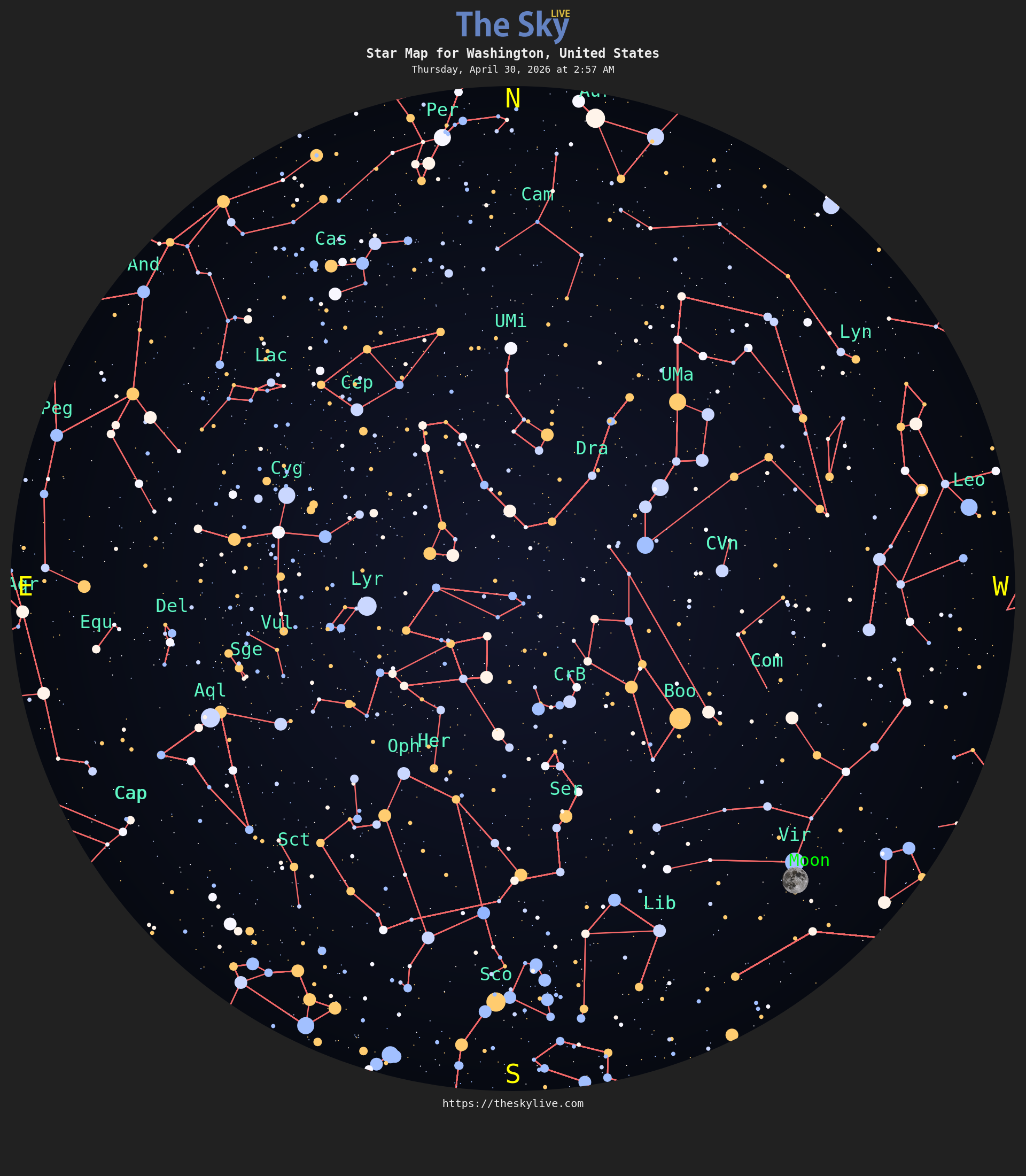
Studying where other constellations are based on a few constellations i can already spot out helped me really figure out my space and other constellations in the real world. It gets really hard when you get to those green and blue areas where there's suddenly hundreds if not thousands of stars and stars you've never seen before near constellations pop up which can muddy their look, especially for longer ones like Ophiuchus & serpens.
One of the cool and imo underrated things about constellations is that you can just simply make your own ! Some stars look like a shape to you ? Make your own custom constellation of it! If you get used to seeing them often you can always find it!
Milky way in particular is always a big topic, but as a general rule:
i wouldn't attempt looking for it until you're at least in the green, and it'll only be seen at some times at night, or not at all depending on the time of year. June-August would be the best times to see it. i got my information from this article, and you should definitely take a look if you're interested, as well as find specific information for it. as like with any astronomical object, it depends on time of year, location, and time of night.
Part 4:
Extra Miscellaneous info:
- Bring snacks ! You're likely going to be out there or traveling out there for a while, especially if you're trying to go anywhere Green or deeper. i also suggest bug repellent, and both a picnic blanket and a regular blanket to have something to lay on and have comfort in!
- Plan your trip, especially gas. If you're going far out there, you want to make sure you planned your gas stops so you don't run out of gas, or so that you can choose your preferred gas stations instead of stopping anywhere you may not wanted to have otherwise.
- Make sure your car is pretty good if you're driving, that your spare is good, etc. You don't want to wait 5 hours for towing and having to be towed a far distance.
- Read up on the area you're going if you're going to a certified spot. Check if it's public or private, whether it's a paid adventure or need to call ahead of time or if you're just gonna be stopping in the middle of a road.
- Download a map if you need to and have any media like your podcasts, books, or music downloaded. There's a very potent chance you may lose connection during the last leg of your trip if you're going somewhere remote, and if that's the case you definitely don't want to get lost because your GPS isn't working. Many maps allow downloading instructions or the area ahead of time.
- Go check out Some of the Light Pollution maps below for an idea of where to go, as well as checking up on any certified dark sky/stargazing spots in your area. Yellow will give you a good idea of whether you'll enjoy this, but green and blue spots will really knock your socks off if you have the travel time to go to!
- Then when you have a day to go, check out the weather, specifically cloud cover and check the moon phase to see when you should go and if that night is a good night. You're looking for low cloud cover and preferably a half moon or less.
- If you have a specific constellation you're looking for, use websites and apps to see if you can find it in your time and what it looks like.
- Bring snacks and maybe bug repellent, plan your trip, read up on the area, and if you're going somewhere very remote make sure to download your map in case there's no cellular coverage.
- Have fun! It's a good activity to do both solo or with friends :3
- lightpollutionmap.info is the most updated global light pollution map, able to be used to plan where you might wanna go
- cleardarksky.com/ doesn't have the most updated map, but it does have a very verbose and intricate description on the colors to better figure out where you might wanna go, especially if you're not versed in what the color scale actually means.
- cleardarksky.com/csk/ also has weather charts in North America for specific dark sky spots. Scroll down and you can either see them listed by area or see a map for each province / state.
- watchthestars.co.uk/tonight/ gives pretty good weather info for a specific zip code / postcode in the EU Area on the night you use it on.
- charts.ecmwf.int/products/medium-clouds gives information on clouds just about anywhere globally. white = not any clouds, and the darket the color is the more rich and dense the cloud is.
- theskylive.com/personalized-star-map can show you a star map of a certain time looks like, if you give it a location and date. Very useful for studying where stars are in reference to each other.
- darksitefinder.com/how-to-see-the-milky-way/ gives very good information on how to see the milky way if you ever wanna see that beauty for yourself.